Why Nikko is worth the day from Tokyo
A mountain pilgrimage town that became a shogun's mausoleum
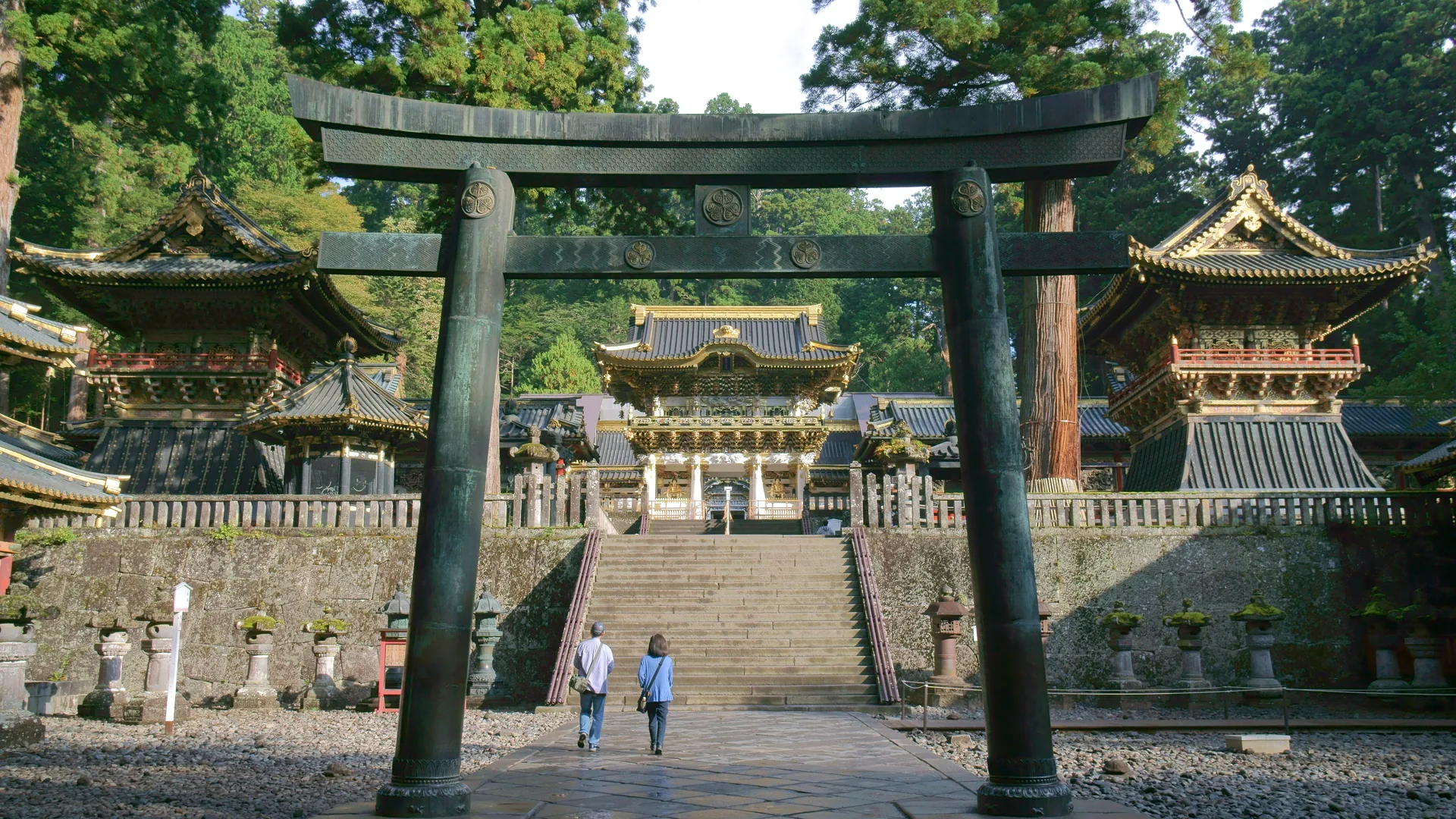
Nikko's religious history goes back to 766, when the monk Shodo Shonin founded a temple here as a base for mountain asceticism in the surrounding peaks. That would probably have kept Nikko a modest pilgrimage site if Tokugawa Ieyasu — the general who unified Japan and founded the Tokugawa shogunate — hadn't been enshrined here after his death in 1616. His grandson, the third shogun Iemitsu, rebuilt the shrine on a scale meant to awe: gold leaf, intricate wood carving, and a builder's budget that historians describe as effectively unlimited for its time. The result, Tōshōgū, is one of the most elaborately decorated religious buildings in Japan and the reason Nikko is a UNESCO World Heritage Site today.
Two very different reasons to make the trip in one day
Most visitors come for one of two things, and the honest answer is that Nikko gives you both without much compromise. The shrine complex — Tōshōgū, plus the neighbouring Futarasan Shrine and Rinno-ji Temple, together inscribed as the "Shrines and Temples of Nikko" — is the cultural half. The mountain road up to Lake Chūzenji and Kegon Falls, roughly 30–40 minutes further by car or bus, is the scenery half. A tour or a well-planned self-guided day covers both; if you're short on time, it's worth deciding upfront which half matters more to you, because rushing both is where days go wrong.
Close enough for a day, far enough to feel like a real trip
Nikko sits roughly 120–140km north of central Tokyo depending on route, which puts it firmly in day-trip range — by direct limited-express train it's under two hours each way from Asakusa, and a tour coach typically takes two to two and a half hours. That's far enough that the mountain air, the cedar-lined approach avenue, and the cooler climate all feel like a genuine change of scene, but close enough that you're back in your Tokyo hotel the same night.
Route
Private car, small-group coach, or the train yourself?
There isn't a single "right" way to do Nikko in a day — the honest trade-off is between cost, flexibility and how much planning you want to do yourself.
The straightforward middle option
Small-group coach tour
A shared coach departs Tokyo early, handles the Tōshōgū entry and the drive up the Irohazaka switchbacks to Kegon Falls and Lake Chūzenji, and drops you back in the evening — typically a 10–10.5 hour day. You lose some flexibility on timing and lunch is usually on your own, but there's no train transfers to plan, no parking to find, and a live guide fills in the history as you go. This is the option most first-time visitors end up happiest with, provided you're comfortable with a fixed itinerary.
The flexible, pricier option
Private car or driver-guide
A private vehicle and guide let you set your own pace — linger longer at Tōshōgū, skip a stop that doesn't interest you, or add somewhere the standard itinerary doesn't cover. It typically costs several times more per person than a shared coach seat (though the per-group price splits well for 3–6 people), and pickup can usually be arranged directly from your hotel rather than a central meeting point. Worth it if flexibility or a small group matters more than the cost difference.
The cheapest, most time-consuming option
Self-guided by train
The Tobu Nikko Line runs direct limited-express trains from Asakusa to Tobu-Nikko Station in under two hours, and Tōshōgū itself is a short bus or taxi ride from the station. Reaching Kegon Falls and Lake Chūzenji self-guided means a further local bus up the Irohazaka switchbacks — doable, but it adds real time to the day and you're managing bus timetables and shrine ticket queues yourself rather than having a guide handle them. This suits travellers who prefer independence and don't mind a longer, less certain day to get it.
Inside the Tōshōgū Shrine complex
Inside the Tōshōgū Shrine complex
The Yomeimon Gate and its 500-plus carvings
The single most photographed structure in Nikko is the Yomeimon Gate, sometimes called the "gate of the setting sun" because visitors were said to lose track of time admiring it until dusk. It's carved with well over 500 individual figures — dragons, sages, animals, floral motifs — picked out in gold leaf and lacquer, and it went through a multi-year restoration completed in the 2010s that restored much of the original colour intensity. It's worth slowing down here specifically; the detail rewards more than a passing glance.
The three wise monkeys, and the sleeping cat
Two of Nikko's best-known carvings are easy to miss if you're moving fast. The "see no evil, hear no evil, speak no evil" monkeys are carved on the sacred stable building near the entrance — the original source of that now-global image. Further in, above a gate near Ieyasu's mausoleum, a small, deceptively simple carving of a sleeping cat (Nemuri-neko) is attributed to a legendary Edo-period sculptor and is treated as one of the shrine's more subtle masterpieces, precisely because it's easy to walk past without noticing.
It's a working shrine complex, not a single building
"Tōshōgū" often gets used loosely to mean the whole visit, but the UNESCO listing actually covers three separate institutions — Tōshōgū itself, the neighbouring Futarasan Shrine (Nikko's older Shinto shrine, dedicated to the mountain gods) and Rinno-ji Temple (a Buddhist temple with its own striking gilded hall) — spread across a forested precinct connected by stone paths and cedar avenues. Budget at least 90 minutes to see the highlights properly; two hours if you want to walk the wider grounds rather than the headline stops alone.
Ways to see Nikko in a day
Find a Nikko day tour for your dates
Every option below is bookable through GetYourGuide, with live availability and the final price shown in your own currency before you pay.
Kegon Falls & Lake Chūzenji
Kegon Falls & Lake Chūzenji
A waterfall born from a volcano
Kegon Falls exists because Mount Nantai, an active-in-geological-terms volcano overlooking the area, erupted and dammed the Daiya River valley, creating Lake Chūzenji behind it. The lake's only outlet drops almost 100 metres in a single sheer fall — commonly ranked among Japan's three most famous waterfalls, alongside Nachi Falls in Wakayama and Fukuroda Falls in Ibaraki. An elevator (paid, separate ticket) descends to a viewing platform at the base, where the scale and the spray are considerably more dramatic than the top-level viewpoint alone.
The Irohazaka switchbacks
Getting up to the lake means climbing roughly 440 metres in elevation via the Irohazaka Winding Road — two separate one-way roads (one up, one down) totalling 48 hairpin turns, each traditionally named after a letter of the old Japanese alphabet ("iroha"). It's a genuinely dramatic piece of driving or busing in its own right, and in autumn the switchbacks themselves — cutting through solid maple forest — are almost as photographed as the waterfall at the top.
Lake Chūzenji at 1,269 metres
The lake sits at roughly 1,269 metres above sea level, which makes the air noticeably cooler and thinner than down in Nikko town, let alone Tokyo — a real relief in midsummer, a reason to bring a layer in spring and autumn, and a reason the lake can see snow well before the town does in winter. Most day-tour itineraries allow a short stop here for the view rather than a full circuit of the shore, since the falls are the priority stop on a single-day schedule.
Which season to go
Which season to go
Nikko's elevation gain — from the town at around 600m to Lake Chūzenji at 1,269m — means the mountain half of the day can run noticeably cooler than Tokyo, and the colour season arrives here well before it reaches the capital.
The single busiest, most photographed season
Autumn — koyo (maple colour)
Nikko's autumn colours typically peak around Lake Chūzenji and the Irohazaka switchbacks in mid-to-late October, roughly two to three weeks before the lower-elevation Tōshōgū shrine grounds turn (usually late October into early November). This is by far the most popular time to visit — book coach tours and trains well ahead, expect the Irohazaka road to be genuinely congested on weekends, and expect Kegon Falls' viewing platforms to be busy.
Cold, quiet, and sometimes icy
Winter
Nikko town gets cold and Lake Chūzenji colder still, with real snowfall a possibility from December through March — the Irohazaka road can close or require caution after heavy snow, so tour operators build in weather contingencies. In return, winter is by far the quietest season at Tōshōgū, and a partially frozen Kegon Falls is a striking, much less crowded sight than the autumn version. Dress for genuine cold, not just a cool day.
An escape from Tokyo's heat
Summer
Tokyo's summer humidity is brutal, and Nikko's elevation makes it a genuine escape — Lake Chūzenji in particular runs several degrees cooler than the city. June brings Japan's rainy season (tsuyu), which can mean overcast, wet days at the falls, so July and August are typically the more reliably dry summer window, alongside larger crowds from domestic school holidays.
GEO/FAQ
Nikko day-trip questions
How far is Nikko from Tokyo, and how long does the trip take?
Nikko is roughly 120–140km north of central Tokyo. By direct limited-express train (Tobu Nikko Line from Asakusa) it's under two hours each way; a tour coach typically takes two to two and a half hours depending on traffic on the way up. Either way, it's a full but genuinely doable single-day round trip.
Can I see both Tōshōgū Shrine and Kegon Falls in one day?
Yes — most day tours and a well-planned self-guided itinerary cover both. The shrine complex takes roughly 90 minutes to two hours to see properly, and the drive up to Kegon Falls and Lake Chūzenji adds another 30–40 minutes each way via the Irohazaka switchbacks. A 10–10.5 hour day, which is the standard tour length, comfortably fits both halves plus a lunch stop.
Is Tōshōgū Shrine actually a UNESCO World Heritage Site?
Yes. Tōshōgū, together with the neighbouring Futarasan Shrine and Rinno-ji Temple, was inscribed by UNESCO in 1999 as the "Shrines and Temples of Nikko." Tōshōgū itself, built as Tokugawa Ieyasu's mausoleum and later rebuilt on a lavish scale by his grandson, is the best known of the three.
Should I book a tour, hire a private car, or go by train myself?
A small-group coach tour is the straightforward middle option — it handles the shrine entry and the mountain drive for you, at a moderate price. A private car or driver-guide costs considerably more per person but gives you full flexibility on timing and stops, and splits reasonably well across a group of 3–6. Going self-guided by train is the cheapest option but adds real time and planning, since reaching the waterfall requires a further local bus up the switchbacks on top of the train journey.
What's the best season to visit Nikko?
Autumn (roughly mid-October to mid-November) has the most famous scenery — the colour peaks at Lake Chūzenji and the Irohazaka switchbacks about two to three weeks before it reaches the lower shrine grounds — but it's also by far the busiest and most congested time to go. Summer is a genuine escape from Tokyo's heat thanks to Nikko's elevation, and winter is the quietest season, with a partially frozen Kegon Falls as a distinctive trade-off for the cold.
How much walking is involved, and is it manageable for most fitness levels?
The shrine complex involves walking on stone paths and some stairs between buildings, and the Kegon Falls viewing platform is reached via a short walk plus an optional paid elevator down to the base — none of it is strenuous hiking. The main physical consideration is the Irohazaka mountain road itself, which is driven or bused rather than walked, though its hairpin turns can be uncomfortable for anyone prone to motion sickness.
Is the tour price shown final, and how does booking work?
You book through GetYourGuide, which shows the final price in your own currency before you pay and states the cancellation policy for your specific date up front — the price you see is the price you pay, with no hidden fees added at checkout. We're an independent day-trip guide, not the tour operator, the shrine or a railway; the booking itself is handled by GetYourGuide's secure checkout.
Do I need to book lunch, or is it included?
On most coach tours, lunch is free time and self-paid rather than included — Nikko is known locally for yuba (delicate tofu-skin cuisine) as well as soba noodle restaurants and casual cafés near the shrine area, and tour guides typically point out a few options rather than pre-booking one for you. If you're self-guided, the same restaurants are an easy walk from Tobu-Nikko Station or the shrine precinct.
Still deciding how to do Nikko in a day?
Leave your email and roughly when you're visiting Tokyo — we'll send a short rundown of the tour, train and self-guided options for your dates.